


| Factor | EDPM | TPO |
| Typical lifespan | 25 years | 15 years |
| Longest documented performance | 30 years | About 30 years |
| Behaviour in deep cold | Stays flexible | Can turn brittle |
| Number of seams | Fewer | More but heat welded |
Thinking about what this table does. This is not just an ordinary comparison that you see every day. This is something that actually determines how EPDM or TPO can determine your roofing future.
Snow melts in the afternoon sun. Water slips into a tired seam. Overnight it freezes, expands and pries that seam a little wider. Repeat that all season and by March you are staring at a brown ceiling stain, soggy insulation and a repair bill nobody budgeted for. Most of those leaks trace back to one decision made years earlier: the membrane on top. That’s why the EPDM vs TPO roofing in Mississauga debate matters more than most property owners realise. Both are single-ply flat roof systems. Both promise long-term protection. EPDM is a rubber membrane that stays pliable in the cold. The guide breaks down cost, lifespan, winter performance and repairs so you can choose the flat roof that actually makes it through the season.
What Is the Difference Between EPDM and TPO Roofing?
EPDM is a black synthetic rubber membrane, and TPO is a white thermoplastic sheet. Both are single-ply flat roof systems. The real differences come down to how their seams are joined and how they handle cold. In the EPDM vs TPO roofing in Mississauga debate, EPDM usually wins on flexibility in the cold while TPO wins on seam strength and energy savings. Here is how they stack up:
- What they are made of: EPDM is a single-ply synthetic rubber. TPO is a single-ply white mixture of synthetic rubber and polypropylene.
- Seams: EPDM seams are glued or taped together. TPO uses heat-welded seams for extra strength.
- Winter performance: EPDM resists heat, ozone and weather well, and it performs especially well in cold weather.
- Energy use: TPO’s white surface reflects UV rays and heat, so it keeps buildings cooler and cuts cooling costs.
The takeaway is that if your roof sees heavy snow and constant freeze-thaw, EPDM’s flexibility counts. If seam strength, foot traffic or summer cooling bills matter more.
Which Flat Roof Handles Mississauga’s Freeze-Thaw Cycles Better?
For most flat roofs in Mississauga, EPDM handles freeze-thaw better. The rubber stays flexible when temperatures swing above and below zero, so it stretches and recovers instead of cracking. TPO can still hold its own on a well-drained roof, especially where welded seams and foot traffic are the bigger worry. In the EPDM vs TPO roofing in Mississauga matchup, winter is where EPDM earns the reputation.
Here is what to decide it:
- Flexibility in the cold: One industry guide notes EPDM roofing is usually best for cold climates.
- Ice buildup: TPO is known for being susceptible to ice buildup during winter months in colder climates, and that puts extra stress.
- Seam behaviour: TPO’s heat-welded seams provide superior strength, so meltwater has a harder time forcing its way in.
- Damage from shovels and ice: EPDM has a known downside. It is relatively easily damaged, so an aggressive snow clearing can tear it.
The membrane is only half the story; ponding water is what really destroys a flat roof in winter. It sits, freezes, thaws and finds every weak point. A properly sloped deck with clear drainage will outlast a premium membrane laid on a flat and poorly drained surface.
How Long Does an EPDM Roof Last Compared to TPO?
A well-installed EPDM roof usually lasts 25 years. TPO typically lasts 15 years, and there is more debate over its real-world lifespan. On longevity alone, EPDM wins the EPDM vs TPO roofing comparison in Mississauga, especially on roofs that go through harsh winters year after year.
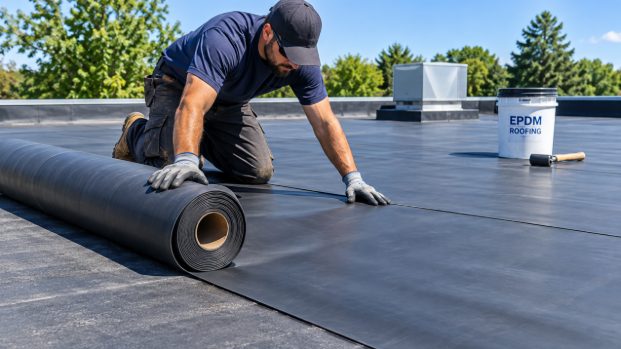
EPDM has the longest track record. An EPDM Roofing Association study examined five EPDM roof systems that were 28 years old. The association also reports that studies of aged EPDM membranes have indicated a potential life expectancy of 50 years. TPO is younger, so the number is less certain. The material became commercially widespread only in the early 1990s. Cold matters too: one comparison notes EPDM stays flexible in cold weather, where TPO becomes brittle, contributing to its longer real-world life.
Warning Signs Your Flat Roof Won’t Survive Another Winter
If water is still sitting on your flat roof 48 hours after rain, if the seams are lifting, or if stains are spreading across the ceiling below, your roof will face the trouble at the right time. Whichever side of the EPDM vs TPO roofing debate in Mississauga your roof is on, these signs mean the membrane is already letting water in or is close to it. Here is a table for you that will justify your thought and help you understand whether your roof is ready for another winter.
|
Warning sign |
What it usually means | What to look for on EPDM | What to look for on TPO |
How urgent |
|
Ponding water |
Poor slope or blocked drains | Puddles that stay for 48+ hours | Dirt rings left behind |
High |
|
Seam seperation |
Water can get under the membrane | Seam tape lifting or curling | Welded seams splitting |
High |
|
Blister or bubbles |
Moisture trapped underneath | Soft and spongy patches | Raised pockets |
Medium |
|
Cracks |
The membrane is aging | Shrinkage pulling at the edges | Chalky and worn top layer |
Medium to high |
|
Ceiling |
An active leak | Shows up inside not on the roof | Shows up inside not on the roof | Urgent |
|
Loose flashing |
Weak spot at walls | Gaps around penetration | Gaps around the curbs |
High |
Winters make every one of these worse. Water that gets into a split seam or a blister freezes overnight, expands and pushes the gap wider. By spring, a small fault can turn into soaked insulation, rotting decking or mould inside the walls. Ponding water is the most common culprit on flat roofs. It adds weight, speeds up wear and gives freeze-thaw cycles a head start. Blocked drains and scuppers are often to blame for clear leaves and debris in late autumn. A professional inspection with photos can catch these problems while a repair still costs far less than a replacement.
Final thoughts
Winter turns small flat roof faults into expensive ones. Water slips into a split seam or blister, freezes overnight and pushes the gap wider. By spring, those tiny flaws can mean soaked insulation, rotting or mould. Ponding water is the biggest culprit, so clear drains and scuppers before the first freeze. Next, check the seams. Aged EPDM tape and badly welded TPO joints both fall under ice pressure.
Want to get a proper photo inspection ?